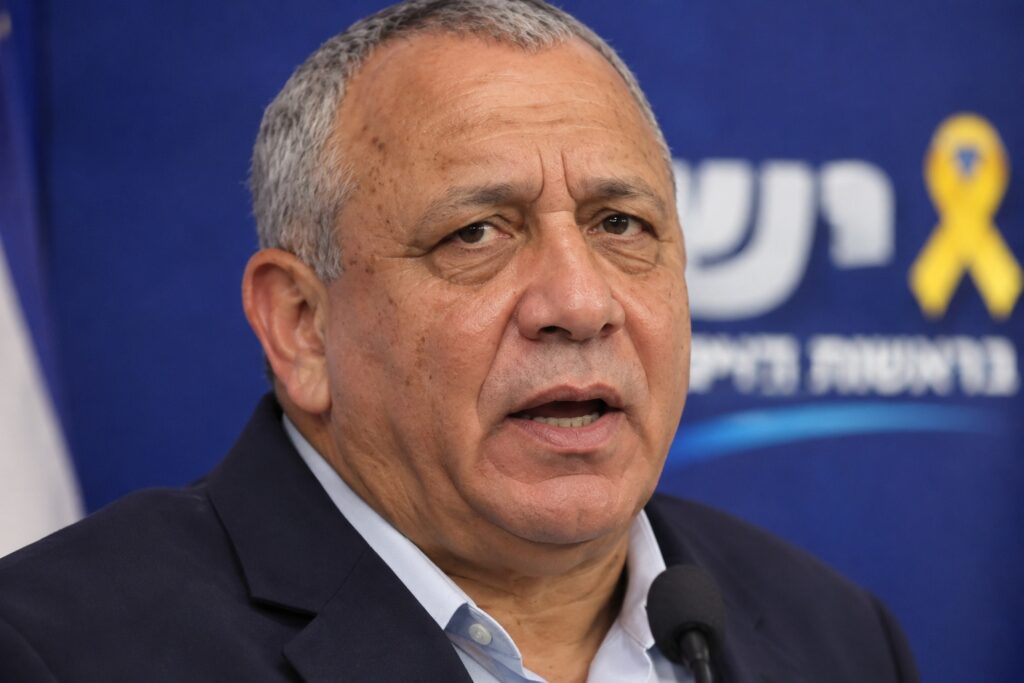
Protesters Accuse Gadi Eisenkot of Killing His Own Son Outside His Herzliya Home

A right-wing demonstration outside the Herzliya residence of Yashar Party chairman Gadi Eisenkot turned ugly Sunday evening when protesters shouted accusations of treason and one demonstrator accused the former IDF chief of responsibility for the death of his son, who was killed fighting Hamas in Gaza.
Several dozen activists assembled near Eisenkot’s home to oppose the possibility of his forming a government dependent on the backing of Arab political parties. The protest came amid negotiations following Israel’s elections for the 26th Knesset, with Eisenkot emerging as a potential candidate to lead the next coalition.
Demonstrators carried placards condemning cooperation with Arab factions, including signs declaring “No leftist government with terrorists,” and “Treasonous leftists endanger Jews.”
The demonstration escalated when one participant directed particularly vicious remarks at Eisenkot’s wife, invoking the death of their son, Master Sergeant (Res.) Gal Eisenkot, who fell in combat in Gaza.
“Your husband is a traitor. He sold your son; he murdered your son. He murdered us and you, and his nephew. Traitor!” the protester shouted at Eisenkot’s wife. Other protesters joined in, chanting “traitor.”
The incident was captured on video, showing the demonstrator directing the accusations toward Eisenkot’s family as other participants continued shouting.
Gal Eisenkot was killed in December 2023 while serving in the Gaza Strip during Israel’s war against Hamas. His death drew widespread attention across Israel, particularly because his father, a former IDF chief of staff, was serving in the country’s emergency wartime government at the time.
The protest centered on the possibility that Eisenkot could seek to establish a governing majority with the parliamentary support of Arab parties. Right-wing activists have strongly opposed such an arrangement, arguing that parties they regard as anti-Zionist should have no role in determining Israel’s next government.
The confrontation followed several days of demonstrations outside Eisenkot’s residence, although earlier gatherings had pressed him to cooperate with Arab parties rather than oppose such an arrangement. On Thursday, approximately 200 demonstrators gathered there to demand a government supported by Jewish and Arab parties.
The election results have left Israel facing a difficult coalition battle. Prime Minister Binyamin Netanyahu’s bloc secured 53 seats in the 120-member Knesset, while Eisenkot’s four-party alliance won 48. Arab parties captured a combined 19 seats, potentially giving Netanyahu’s opponents the parliamentary numbers needed to establish an alternative government.
However, Eisenkot had ruled out governing with Arab parties during the election campaign, and disagreements among the opposition factions have complicated efforts to assemble a majority. President Isaac Herzog is expected to consult with the newly elected parties before deciding which candidate should receive the mandate to form the next government.