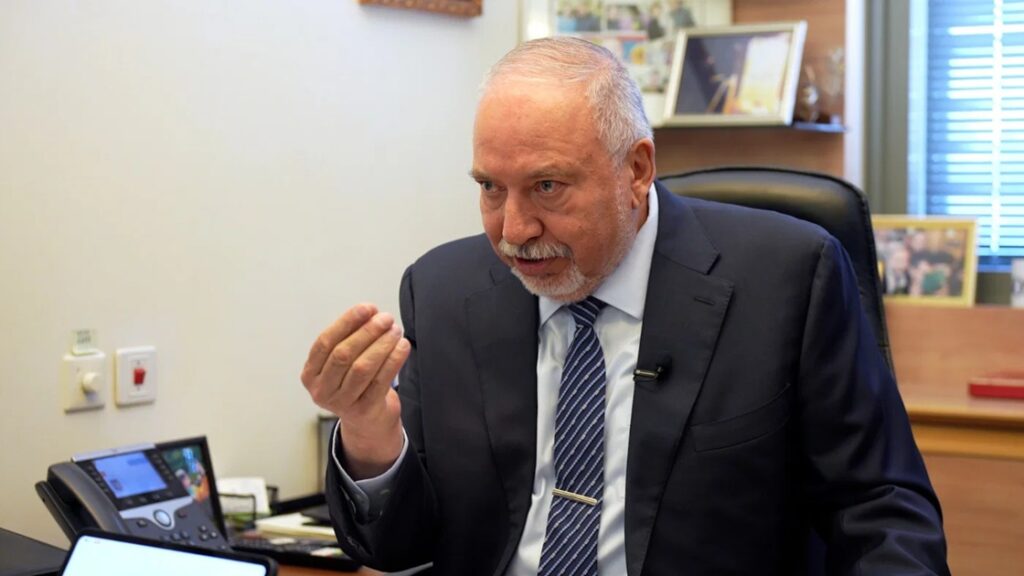
Lieberman Opens Door to Draft Compromise as Chareidi Parties Weigh Joining Eisenkot Government

A dramatic shift in Israel’s coalition negotiations emerged Friday after Yisrael Beiteinu chairman Avigdor Lieberman announced his willingness to compromise on the military draft issue, prompting senior figures in United Torah Judaism to openly consider joining a government headed by Gadi Eisenkot. The development could potentially bring Shas into the emerging coalition as well, although significant political and ideological obstacles remain.
A source within United Torah Judaism told Kikar HaShabbat that the party is seriously examining the possibility of entering a government led by the anti-Netanyahu bloc, provided an acceptable agreement can be reached guaranteeing the status of yeshiva bochurim.
“We’re not particularly surprised. We’ve been hearing these discussions since the elections. We’ve spoken with people in the change bloc, and we understood where things were heading,” the source said.
The official made clear that securing draft legislation remains the party’s overriding priority and could determine its willingness to cooperate with politicians who have long opposed the chareidi position.
“If they give us a draft law, we’ll go with them. Absolutely. That’s the most important thing right now. Once that is resolved, the budgets will also be released. We’re in politics, and in politics you do what needs to be done,” the source declared.
Lieberman’s unexpected flexibility represents a significant development given his years of opposition to military service exemptions for yeshiva students. On Friday morning, he announced that although he remains firmly opposed to establishing a minority government dependent on the abstention of the Joint List and Ra’am, he is prepared to make concessions on other contentious issues to prevent another election and keep Binyamin Netanyahu out of power.
“On all other issues, it is permissible and desirable to be flexible and compromise, and to understand that if you try to grab too much, you end up with nothing. That includes the issue of the draft law,” Lieberman wrote.
“I find it painful, and I know many others do as well. But in light of the many challenges we face today, the national interest of the State of Israel and the Jewish people must take precedence over every other consideration,” he added.
Conversations with Yisrael Beiteinu lawmakers and candidates indicate that party officials believe a draft compromise could be politically viable if advanced by the anti-Netanyahu bloc. Asked how such a concession could be reconciled with their election promises, party representatives argued that the alternatives would be a government dependent on Arab parties, renewed cooperation with Netanyahu, or another national election, none of which Lieberman considers acceptable.
United Torah Judaism chairman MK Yaakov Asher responded to Lieberman’s announcement with pointed criticism of the years of political confrontation surrounding the draft.
“It’s encouraging to discover the flexibility of all the political players on the draft issue,” Asher remarked. “It’s painful to think how much incitement and hatred between brothers could have been avoided had that same flexibility been demonstrated in recent years.”
Asher also emphasized that the party’s elected representatives would not independently decide whether to enter a coalition or accept proposed legislation. Any arrangement would first require the approval of the Gedolei Yisroel.
“Of course, every proposal will first be brought before the ‘mechutanim’ — the Gedolei Hador, shlita — for their decision,” he stated.
Despite the apparent opening, United Torah Judaism officials acknowledge that negotiations with Eisenkot could prove extremely difficult. Lieberman’s willingness to compromise does not necessarily mean that the parties can agree on the substance of a draft law, particularly regarding enlistment quotas and financial or legal penalties for yeshivos and their students.
Political observers believe the chareidi parties would be unlikely to support legislation containing substantial sanctions or rigid recruitment requirements. Any agreement capable of securing their participation would therefore likely require a considerably softer framework than proposals previously advanced by Lieberman and other opposition figures.