Giant Tehran Billboard Depicts Trump Behind Bars With Chilling Message

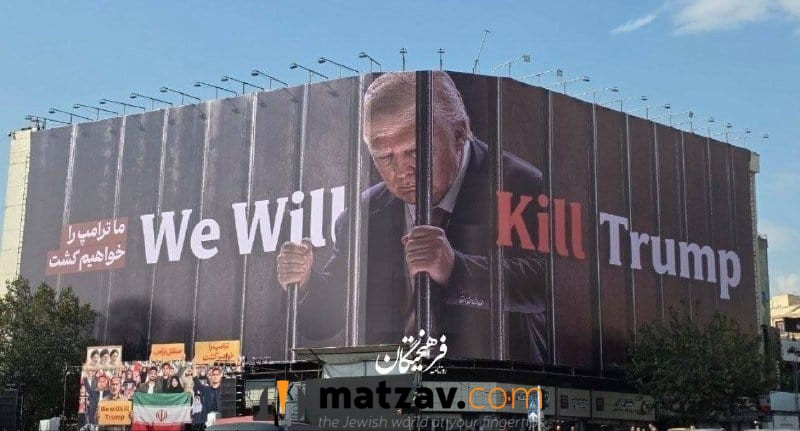
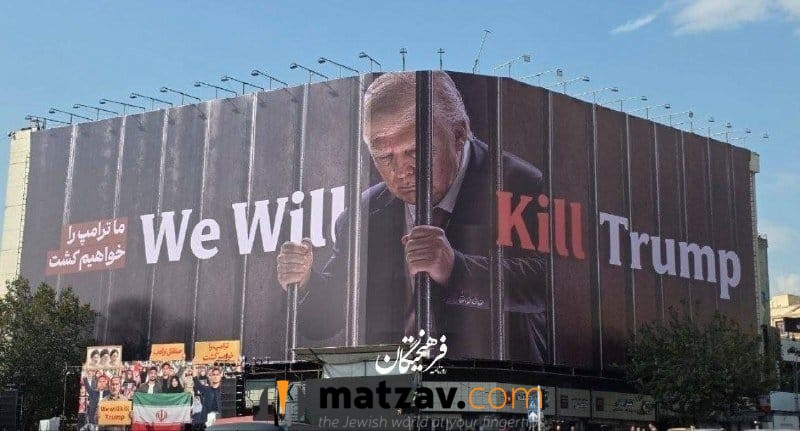
A massive billboard in Tehran’s Revolution Square has displayed an explicit death threat against President Donald Trump, featuring an enormous image of the American president gripping prison bars alongside the words “We Will Kill Trump.”
The provocative display, erected at one of the Iranian capital’s prominent public gathering places, shows Trump with his head lowered and his hands wrapped around the bars of what appears to be a prison cell. The words “We Will” appear in large white lettering, followed by “Kill” in red and “Trump” in white.
The billboard also includes a message in Persian expressing the same threat, making the display unmistakably directed at the American president.
The threatening imagery represents another example of the openly hostile rhetoric directed at Trump by elements within Iran, where calls for retaliation against the United States have featured prominently in political messaging.
The billboard was unveiled Tuesday, November 3, amid renewed tensions between Washington and Tehran following American military strikes against Iranian targets near the Strait of Hormuz.
Trump confirmed Tuesday that U.S. forces had struck an Iranian anti-aircraft installation on Qeshm Island, describing the operation as a limited military action. The strikes followed reports of Iranian forces firing at an American aircraft.
The new billboard was accompanied by other threatening displays throughout Tehran. Another large poster depicted Trump alongside Vice President JD Vance, U.S. special envoy Steve Witkoff and Israeli Prime Minister Binyamin Netanyahu, showing the four leaders with bloodied faces and torn clothing against damaged American and Israeli flags.
Dozens of Iranians gathered in Revolution Square carrying red flags and banners bearing the warning “There will be blood,” while demanding revenge for the killing of Iran’s Supreme Leader Ayatollah Ali Khamenei during the American-Israeli strikes that began on February 28.
Since the outbreak of the war, Iranian authorities have repeatedly used public displays to ridicule Trump and promote threats of retaliation. Previous installations have depicted the president inside a coffin, while other exhibits have portrayed him injured or imprisoned.
In northern Tehran’s Tajrish Square, an outdoor exhibition featured paintings showing Trump bloodied on the ground and another depicting an explosive device covering his face. A nearby installation included a replica prison cell occupied by an actor impersonating the American president.
The latest threats come as diplomatic efforts continue to prevent another major escalation between the United States and Iran. Despite the renewed military activity, Trump has indicated that an agreement with Tehran remains possible.
Iranian officials, however, have continued issuing warnings. Mohammad Bagher Ghalibaf, a leading Iranian negotiator, declared that the country was prepared for renewed fighting, while Deputy Foreign Minister Kazem Gharibabadi asserted Iran’s right to respond militarily to American attacks.
Iran has long used enormous billboards and murals in prominent public locations to communicate political messages, particularly against the United States and Israel. Such displays have been a regular feature of the country’s political landscape since the 1979 Islamic Revolution.