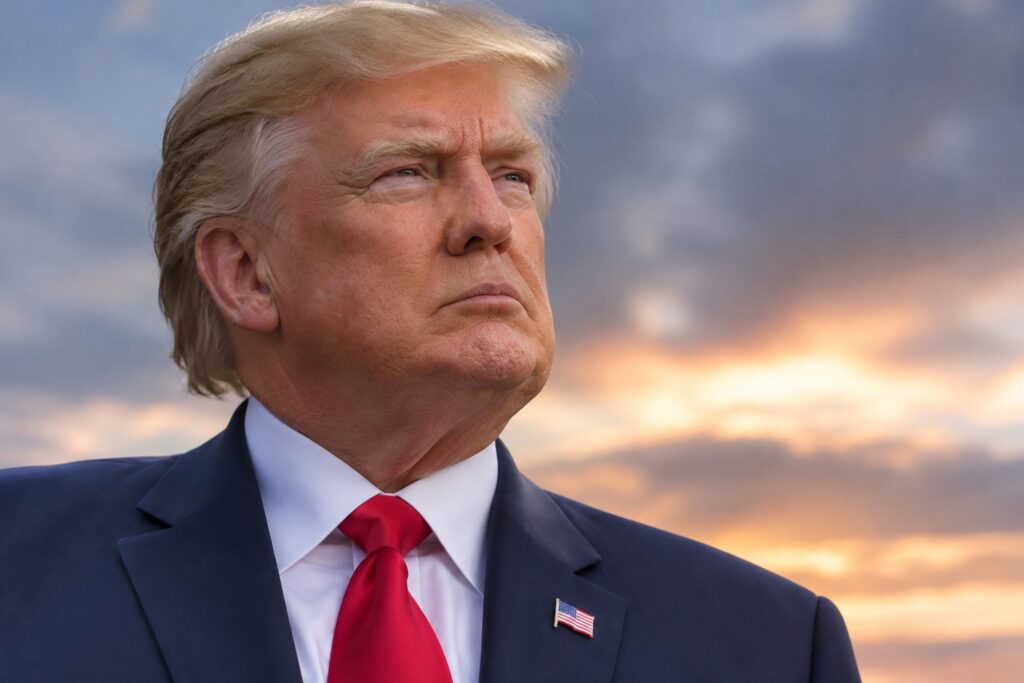
Trump Blames Democratic Election Victories for Wall Street Plunge, Warns Americans About 401(k) Losses


President Donald Trump blamed Democrats’ sweeping midterm election victories for Thursday’s sharp stock market selloff, accusing the party of triggering massive losses on Wall Street just two days after winning control of both chambers of Congress.
The president argued that the election results had shaken investor confidence and damaged retirement accounts, even as he predicted that the American economy would eventually recover and reach new heights.
“The Stock Market suffered one of the Worst Days in History based on the results of the Election,” Trump wrote Thursday in a post on Truth Social. “Such a sad thing to watch! It took so much work to get us to a level that no one has ever seen before, and then this.
“Your 401(k)s have, therefore, dropped. Remember, it wasn’t Republicans, it was Dumocrats,” Trump added. “Do not fear, however, we will soon, one way or the other, be BIGGER AND STRONGER THAN EVER BEFORE. MAKE AMERICA GREAT AGAIN!”
Wall Street suffered substantial losses during Thursday’s session, with the Dow Jones Industrial Average tumbling 1,833.06 points. The technology-heavy Nasdaq Composite plunged 5.52%, pushing it more than 10% below its record high from the previous month, while the S&P 500 declined 4.36%.
Technology companies, particularly those tied to artificial intelligence, semiconductor manufacturing, and data center construction, were among the hardest hit as investors reassessed the potential consequences of the Democratic takeover of Congress.
According to CNBC, market participants have grown concerned that Democratic lawmakers could introduce policies that slow the expansion of AI infrastructure, an industry that has helped drive economic growth and stock market gains in recent years.
Semiconductor giants Broadcom and Nvidia suffered especially severe declines, with their shares falling approximately 10% and 9%, respectively. Qualcomm and Oracle also recorded significant losses as the technology sector endured a second consecutive day of selling.
Tim Holland, chief investment officer at Orion, said investors appeared reluctant to maintain their exposure to AI-related companies until the implications of the election became clearer.
Investors are “stepping away until they get a better sense of the implications of the midterms around the AI capex cycle in particular, which is the biggest economic tailwind we’ve had going for us for the last, call it, three years,” Holland told CNBC.
“It’s about tone and tenor from the party that did really well, incredibly well, at the federal level and at the state level,” Holland added.
The sharp decline followed a very different market reaction Wednesday, when stocks surged in the first trading session after the midterm elections. The Dow gained more than 1,500 points that day, recording its strongest performance since April 2025, when Trump announced a temporary suspension of reciprocal tariffs.
The S&P 500 and Nasdaq also finished Wednesday higher, although their gains were considerably smaller than the Dow’s.
Tuesday’s elections delivered major victories for Democrats, who recaptured both the House of Representatives and the Senate. The party flipped at least 39 House seats and at least seven Senate seats, giving it control of the legislative branch for the final two years of Trump’s presidency.
Additional market reporting showed that Thursday’s selloff wiped out roughly $5.4 trillion in combined market value from companies in the S&P 500 and Nasdaq, while the Nasdaq recorded its worst single-day performance in approximately 18 months.
The selloff was particularly severe among companies involved in building artificial intelligence infrastructure. Investors were weighing the possibility that newly elected Democratic officials could impose restrictions on data center construction, including in states where the industry has been expanding rapidly.
The downturn also reflected broader concerns about the enormous sums being invested in artificial intelligence and whether those expenditures would produce sufficient returns. Losses spread beyond technology stocks as the trading session progressed.