Letter: If Cirrus Planes Have Parachutes, Why Don’t Larger Private Jets?

Click here to join the official TLS Community:
Before anything else, my condolences to the families of the nine people who lost their lives in Sunday’s Learjet crash in Palm Beach County. No family should have to receive that news.
The NTSB is investigating the November 1 crash of a Learjet 60 traveling from Austin to the Bahamas. Investigators have said there are indications the aircraft began breaking up before impact. The investigation is still in its early stages, and the cause has not been determined.
I am not a pilot or an aircraft engineer. I cannot say a parachute would have saved this flight. But this tragedy leaves me with a question I would like aviation professionals to answer: why aren’t whole-aircraft parachutes required on more airplanes?
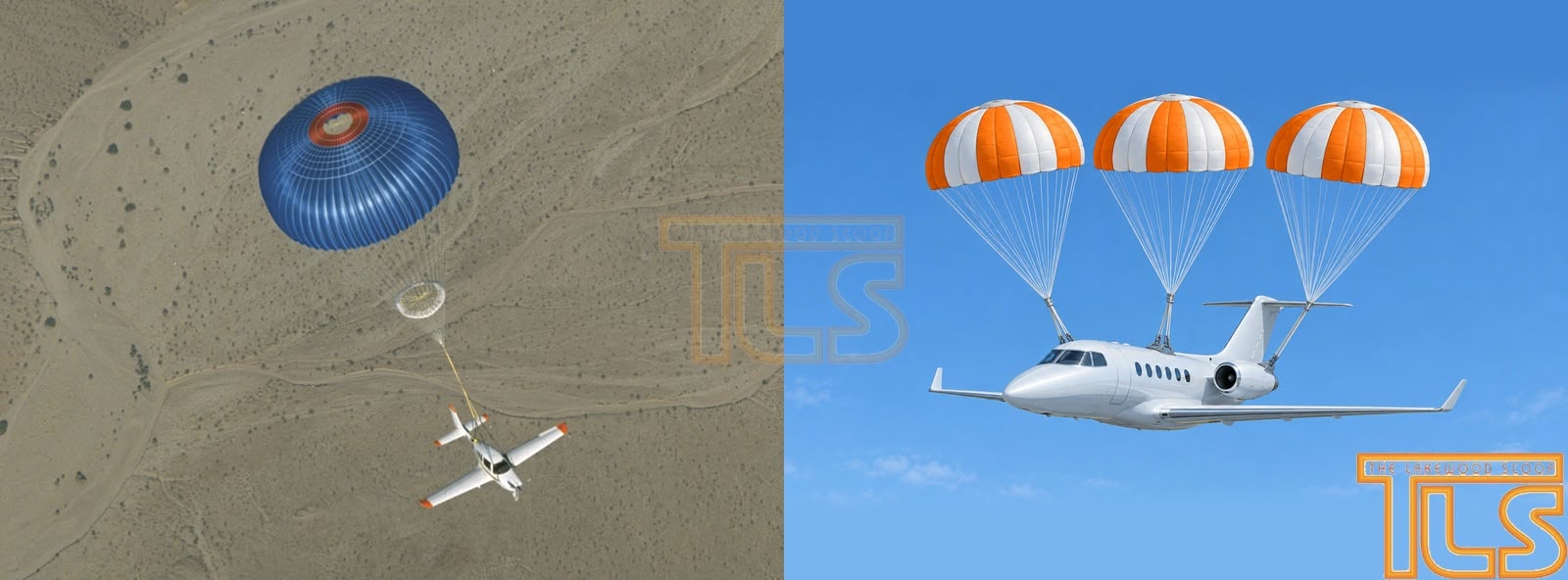
Cirrus has shown that the idea is real. Its Cirrus Airframe Parachute System, known as CAPS, uses a rocket-deployed parachute to lower the aircraft with its occupants still inside. In an October 19, 2026 announcement, Cirrus said more than 300 people had returned home safely to their families because CAPS was included on its aircraft. That is the manufacturer’s figure across its aircraft fleet, not a count limited to jets.
And this is not limited to small propeller planes. The Cirrus Vision Jet already comes with CAPS. So my question is about extending that protection to larger private jets, even if applying it to every commercial airliner is a much bigger challenge.
Could several parachutes, rather than one, be designed to support a larger aircraft? Could they be deployed in stages to slow it down before fully opening? What would engineers have to solve to make that safe?
NASA has described research into stronger, lighter parachutes and deployment systems for larger aircraft. It also identified bulk, weight and the forces involved in opening a parachute as obstacles. I am not suggesting that adding extra parachutes is a simple retrofit. I am asking whether the obstacles can be overcome, and what it would take.
I also wonder about automatic activation. If an aircraft enters an extreme, uncontrolled descent and the crew cannot respond, could a carefully designed system deploy without waiting for someone to pull a handle? How would it distinguish a genuine emergency from a recoverable maneuver, and prevent an accidental deployment that creates another emergency?
The possibility of a breakup raises an even harder question. Is there any stage at which a parachute could protect the occupied cabin, or would the speed, structural damage or loss of attachment points make it ineffective? That is a question for engineers, not something a reader can answer by looking at a video.
For clarity, the accompanying Cirrus photograph shows an actual SR20 parachute deployment. The larger-jet image beside it is a generated concept I made for illustration only. It is not an existing certified system or an engineering demonstration.
I would like pilots, aircraft designers, manufacturers and safety regulators to weigh in. What are the limits? What research is underway? Which types of private aircraft could realistically benefit? If a system can be proven to save lives without creating greater risks, should it become mandatory for those aircraft?
We should not claim to know how this particular crash could have been prevented. We should let the investigators do their work. But we can still ask whether more families could be protected in the future.
TLS welcomes your letters by submitting them to us via Whatsapp or via email [email protected]